Ideal firing time from your inputs
Example numbers only. Constant fire rate, all shots hit, unchanged effective damage; time starts at the first shot. No reload model.
Use effective damage from the situation you are comparing
Enter target health and the damage actually applied per successful shot after the relevant mitigation. Do not enter a weapon’s advertised base damage and assume it already accounts for armor, range or hit location. All default values in this calculator are examples; they do not belong to a named Marathon weapon.
The formula, including the first-shot convention
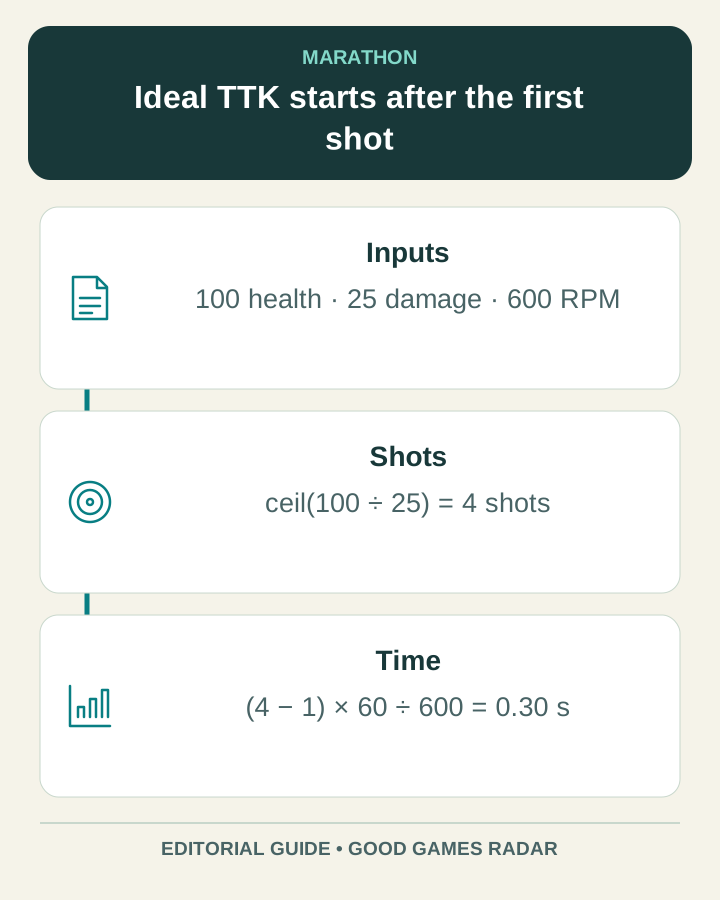
Shots required = ceil(target health ÷ effective damage per shot). For a constant-rate weapon, ideal time after the first shot = (shots required − 1) × 60 ÷ rounds per minute. The first shot happens at time zero. A one-shot result therefore shows zero additional firing time, not zero reaction, aiming or projectile travel time.
| Illustrative input | Result |
|---|---|
| 100 health; 25 damage; 600 RPM | 4 shots; 0.30 seconds after the first shot |
| 100 health; 34 damage; 600 RPM | 3 shots; 0.20 seconds after the first shot |
| 100 health; 100 damage | 1 shot; 0.00 seconds after the first shot |
A magazine that is too small needs another model
The calculator checks magazine capacity. If the required shots exceed it, the result gives the shot count and withholds a complete TTK estimate. It does not silently assume an instant reload. Patch 1.1.9.5 explicitly corrects the Repeater HPR description to say that it reloads two rounds at a time, illustrating why one generic reload delay does not describe every weapon.
Source: Official Repeater description correction
Compare one variable at a time
- Use the same target and hit location for both candidate weapons.
- Record the game build, source of each value and whether damage was measured or read from a tooltip.
- Change damage and RPM, then rerun the calculator. Keep the magazine constraint visible.
- For burst, charge, spin-up or multi-pellet behavior, use a measured shot timeline instead of treating the nominal RPM as uniform.
- Keep practical accuracy and exposure time beside the result. A lower ideal number alone does not establish a stronger loadout.
What is deliberately outside this calculation
This tool does not connect to your account or retrieve live weapon data. It excludes changing damage, missed rounds, reload timing, status damage, aim delay and networking effects. It is a transparent arithmetic aid for comparable inputs, not a current weapon tier list.
Continue with this game
Sources & scope
This article uses the official and individually identified community references linked below. It is not a hands-on review. Screenshots are credited to their original publishers; they are not evidence that we tested these steps. Game details can change after publication.
- Bungie · update 1.1.9.5 (20 Oct 2026)
- Bungie · Season 2 weapons and systems (27 May 2026)
Sources checked: 22 Oct 2026. Read how we use sources and AI assistance.